
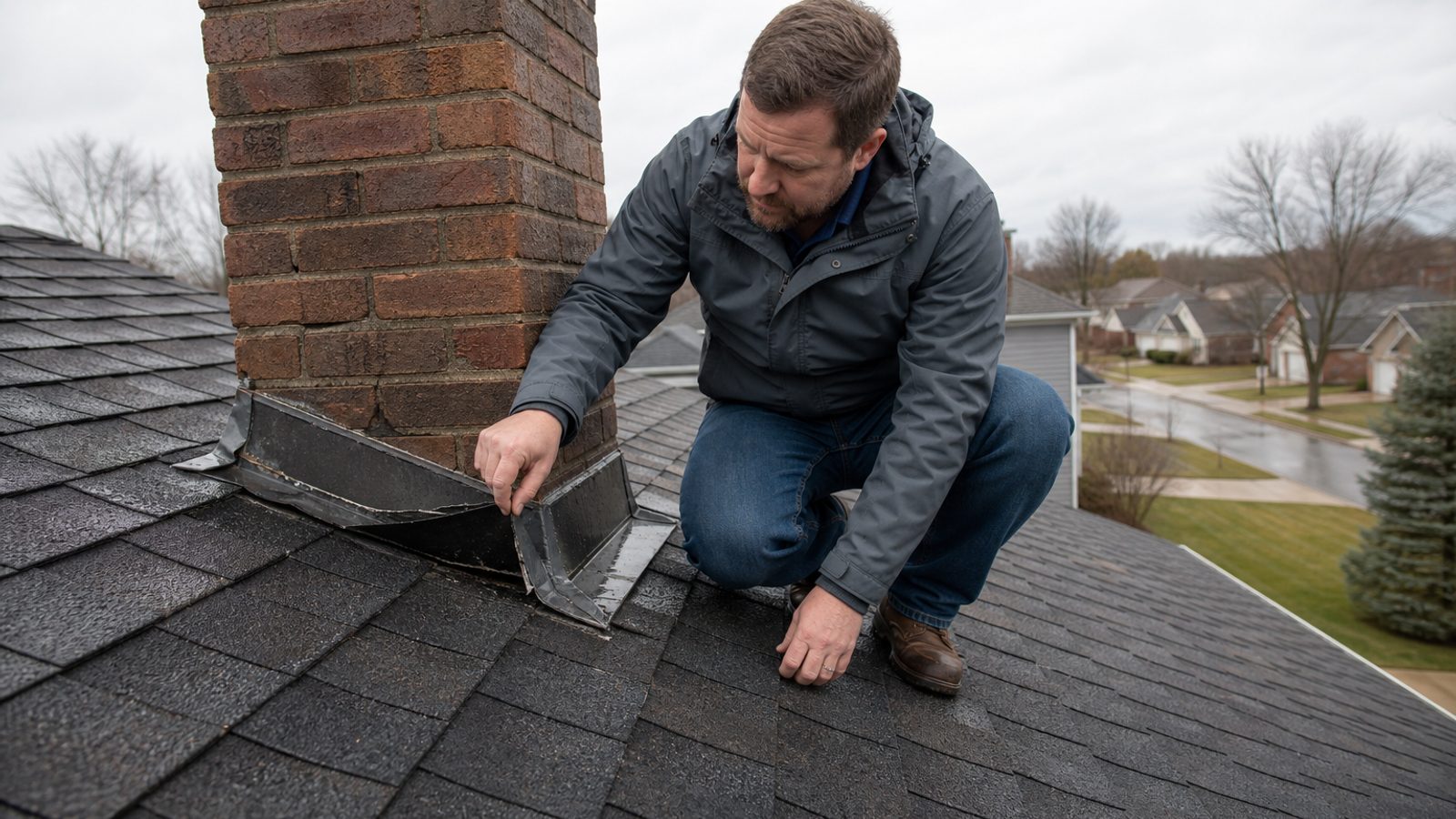
By the time a brown ring shows up on your ceiling, the leak that caused it has usually been going on for a while. Roof leak detection isn’t about waiting for the obvious sign. It’s about catching the small clues that show up weeks or months earlier, while the fix is still simple. Here’s what we look for, and what you can check yourself, before a slow leak turns into a bigger repair.
Why Leaks Hide for So Long
Water is patient. It rarely drips straight down from the point where it enters the roof. Instead it follows the underside of the roof deck, runs along a rafter or a piece of framing, and shows up on your ceiling several feet from where it actually got in. That’s why a stain in the corner of a bedroom can trace back to a flashing gap near the chimney on the opposite side of the house.
Insulation makes it worse. A soaked patch of attic insulation can hold water for a long time before enough of it soaks through the drywall for you to notice. By the time you see a stain, the wood underneath has often been wet for weeks, which is exactly the environment mold and rot need to get started.
The Signs Most Homeowners Miss
A few things worth checking every few months, especially after a hard rain or a wind event:
- Musty smell in a closet, bedroom, or attic access. Damp wood and wet insulation have a distinct smell before you ever see a stain.
- A slightly darker or discolored patch on a ceiling or upper wall, even if it’s faint. It doesn’t need to be a full ring to mean something.
- Peeling paint or bubbling drywall texture, which happens when moisture gets behind the surface and pushes it out.
- Granules collecting in your gutters or at the base of downspouts. Asphalt shingles shed more of their protective granules as they age, and a sudden increase after a storm can point to hail or wind damage that’s opened up a path for water.
- Daylight visible through the attic roof deck, which you can only catch by actually going up and looking, ideally with the lights off.
- A higher than usual energy bill, which sounds unrelated but often means wet insulation has lost its ability to do its job.
None of these alone proves you have a leak. Together, or even one showing up more than once, is worth a closer look.
Where Leaks Actually Start
Water almost never gets in through the flat, open part of a shingle roof. It gets in wherever the roof has a seam, a penetration, or a transition, because that’s where the weatherproofing depends on installation detail rather than the shingle itself.
The usual suspects are flashing around chimneys, vent pipes, and skylights, valleys where two roof slopes meet, and the seal around anything that pokes through the roof deck. Ice and hard freezes in the winter can also work flashing loose or crack sealant that looked fine the season before, so a roof that was watertight last year isn’t guaranteed to be watertight this year. Age matters too. Shingles that are curling, cracking, or losing granules faster than they should are giving water more opportunities to find a way in, even without an obvious storm event.
What to Do If You Suspect a Leak in Indianapolis
Central Indiana’s weather doesn’t make this easy. We go from hard winter freezes to spring hail and straight-line wind storms to hot, humid summers, and a roof takes damage in every season, not just the dramatic ones. A lot of the leaks we get called out for in Greenwood, Franklin, Center Grove, and across the south side of Indianapolis started with a storm that didn’t look like a big deal at the time.
If you notice any of the signs above, the smart move is a roof inspection before you start opening up drywall. We check the roof itself, the flashing and valleys, and get into the attic whenever we can to look at the underside of the deck, because that’s where the real story usually is. Catching a leak at the flashing-repair stage instead of the sagging-ceiling stage is the difference between a small job and a much bigger one, and it’s almost always the difference in cost too.
What Happens If You Wait
We understand the instinct to wait and see, especially if the sign is subtle, like a faint discoloration or a musty smell that comes and goes. But roof leaks don’t fix themselves, and they rarely stay small. Wet insulation stops insulating. Wet framing can rot. And mold, once it gets established in an attic or behind a wall, is a separate problem on top of the roof repair itself.
The good news is that most leaks we catch early are straightforward repairs, often addressing a section of flashing or a handful of shingles rather than anything close to a full replacement. The earlier we look, the more likely that’s the outcome.
We’re Here to Help
If you’ve noticed a musty smell, a faint ceiling stain, or granules piling up in your gutters, don’t wait for it to get worse. We offer free, no-obligation inspections for homeowners across the Indianapolis area, including Greenwood, Franklin, Whiteland, Bargersville, and Mooresville. Call or text us at (317) 883-7537, or reach out anytime at simpleroofingllc.com. We’ll tell you straight what we find.
Suggested images: (1) An inspector examining a ceiling water stain with a homeowner, alt text “Inspecting a ceiling stain caused by a hidden roof leak in Indianapolis.” (2) A close-up of cracked or lifted flashing around a chimney, alt text “Damaged roof flashing that can lead to a hidden leak.”